The Mardi Himal Trek is a 10-day Himalayan journey through one of the Annapurna region's quietest and most scenic corners, offering close-up views of Machapuchare and the wider Annapurna range without the crowds found on more established routes. Starting in Kathmandu, the itinerary moves through Pokhara and onto the trail itself, climbing steadily through forest, ridge, and alpine terrain via Australian Camp, Kokar Forest Camp, Low Camp, and High Camp before reaching Mardi Himal Base Camp at 4,500 metres. The trek is graded moderate, requires no technical climbing experience, and is supported throughout by professional guides, porters, teahouse accommodation, and all necessary permits. With a built-in acclimatisation profile, varied terrain, and a short but rewarding overall length, this package suits first-time trekkers and seasoned Himalaya-goers alike who want a genuine mountain experience in a condensed timeframe.
DestinationNepal
Duration10 Days
GradeEasy
ActivitiesTrekking/HIking
AccommodationHotel/ Lodge/ Guesthouse
Group SizeMin. 1 Pax
VehiclePrivate Vehicle/ Tourist Bus
MealsBreakfast, Lunch & Dinner
Highlights of Mardi Himal Trek
Mardi Himal Base Camp (4,500m) – Stand at the foot of the Mardi Himal massif with a close-up panorama of Machapuchare, Annapurna South, and surrounding peaks.
Ridge-top trail with open mountain views – Walk the dramatic Mardi Himal ridge from Low Camp to High Camp with uninterrupted 270-degree Himalayan views.
Uncrowded and off-the-beaten-path – One of the least trafficked trails in the Annapurna region, offering peace and solitude.
Diverse landscapes – Trek through terraced fields, dense rhododendron and oak forests, high-altitude meadows, and alpine zones all in one trip.
Annapurna Conservation Area (ACAP) – Trek inside one of Nepal's most biodiverse protected regions, home to rare wildlife and rich forest ecosystems.
Australian Camp (Thulo Kharka) – A beautiful hilltop meadow with sweeping valley views, popular for overnight stays and sunrise scenery.
Gurung and Magar village culture – Experience the warm hospitality and living traditions of indigenous mountain communities along the trail.
Siding Village descent – A scenic finish through an authentic rural village, rarely visited by trekkers, before driving back to Pokhara.
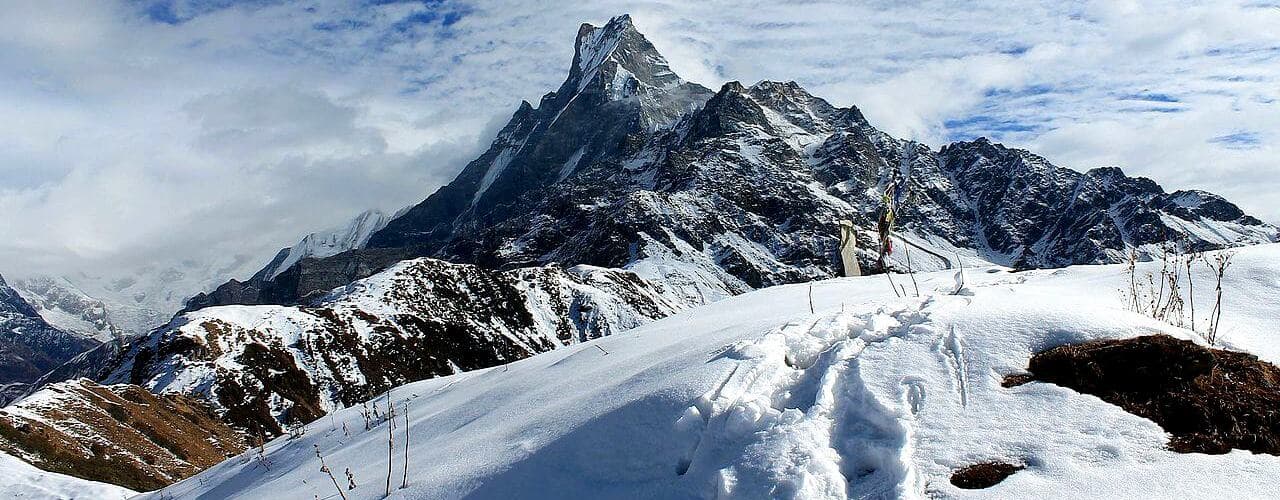
Close-up view of Machapuchare (Fishtail Mountain) – Few treks offer such proximity to this sacred and striking peak as the Mardi Himal trail.
Short and efficient itinerary – 10 days total from Kathmandu, making it ideal for travellers with limited time who still want a full mountain experience.
Teahouse trekking with included meals – Comfortable, authentic lodge accommodation with breakfast, lunch, and dinner included throughout the trek.
Expert local guide and porter service – Professional guidance from a team based in Pokhara with deep knowledge of the Mardi Himal trail.
Trip Overview
Mardi Himal Trek
A secluded escape in the heart of the Annapurna range, the Mardi Himal Trek offers an intimate and breathtaking journey to the base of Machapuchare, the ‘Fishtail’ mountain. Unlike the more frequented Annapurna Base Camp trek, this relatively new route stays uncrowded, ensuring an authentic and serene experience for trekkers. The 10-day expedition takes you through stunning rural landscapes and thick forests to an awe-inspiring altitude of 4,500 metres, where the Himalayas feel palpably close. Perfect for beginners and seasoned hikers alike, Mardi Himal is a gateway to Nepal’s wild beauty and cultural soul.
This 10-day Mardi Himal Trek itinerary starts from Kathmandu, proceeds to the enchanting lakeside town of Pokhara for an overnight stay, and then commences with the trail from Kande. The journey ascends along the Mardi Himal ridge, taking trekkers from initial villages through verdant forests and open ridges until they reach Mardi Himal Base Camp. The total distance covers around 50-55 kilometers spread over six walking days.
The highest elevation reached is at Mardi Himal Base Camp (4,500 metres), offering unparalleled mountain vistas.
The route passes through settlements like Australian Camp (Thulo Kharka), Kokar Forest Camp, Low Camp, and High Camp before the memorable ascent to the base camp. Descending through the picturesque village of Siding, trekkers return to Pokhara, concluding the trek where it began in Nepal’s adventure capital.
Throughout the Mardi Himal Trek, you’ll be enveloped by a kaleidoscope of landscapes and vibrant cultural interactions within the Annapurna Conservation Area. Keep an eye out for red pandas and rare birds. The trail offers a genuine connection to local Gurung and Magar life in their remote mountain villages.
At 4,500 metres at the base camp, panoramic and unobstructed views of Machapuchare (6,993m), Mardi Himal (5,587m), Annapurna South, and Hiunchuli unfold before you.
The profound sense of tranquility and rugged grandeur found here makes this trek an exceptionally special and unhurried encounter with the giants of the Himalayas.
The most favorable seasons for this trek are spring (March-May) and autumn (September-November). During spring, rhododendron blossoms create a riot of colours across the hillsides. Autumn delivers crisp air and excellent visibility after the monsoon has cleared the sky.
The Mardi Himal Trek is rated moderate in difficulty, making it an excellent choice for both novice and experienced hikers, with average daily walking hours between 4 to 6.
Teahouse accommodation is cozy and comfortable. Partner with our experienced local team from Pokhara to craft your ultimate Mardi Himal Trek adventure – personalized, safe, and utterly unforgettable.
Itinerary of Mardi Himal Trek - 10 days
Day 01
Arrival in Kathmandu (1,400 m)
Your Mardi Himal Trek adventure begins the moment you land at Tribhuvan International Airport in Kathmandu, Nepal's historic capital city sitting at 1,350 metres above sea level. Our representative will be waiting to greet you in the arrivals hall with your name on a welcome board, and you will be transferred comfortably to your hotel in a private vehicle. After checking in and freshening up from your journey, you will meet with your trek coordinator for a comprehensive briefing covering the full 10-day itinerary, packing checklist, trail conditions, permits, and any questions you may have. This is a great time to visit a nearby trekking gear shop if you need any last-minute equipment. For the evening, Kathmandu's vibrant Thamel neighbourhood offers a wealth of restaurants, cafés, and cultural sights to explore at your own pace. Overnight at a 3-star hotel in Kathmandu.
Max. Elevation:1,400m
Day 02
Drive from Kathmandu to Pokhara (822m) – 6 to 7 Hours
After breakfast at your hotel, you depart Kathmandu for the scenic overland journey to Pokhara, Nepal's gateway to the Annapurna region. The drive takes approximately 6 to 7 hours along the Prithvi Highway, following the winding course of the Trishuli and Seti rivers through lush mid-hill landscapes. This is a beautiful journey in its own right, passing terraced hillsides, gorges, and traditional villages. Alternatively, if you prefer to save time, a 25-minute domestic flight from Kathmandu to Pokhara is also available (flight cost not included in the package). Upon arrival in Pokhara, you check in to your 3-star hotel overlooking the Phewa Lake. The afternoon is free for leisurely exploration — a boat ride on the lake, a visit to the World Peace Pagoda, or simply relaxing and preparing your gear for the trek ahead. Your guide will conduct a final gear check this evening. Overnight at a 3-star hotel in Pokhara.
Max. Elevation:850m
Duration:5 to 6 Hours
Distance:203km
Day 03
Drive to Kande then Trek to Thulo Kharka / Australian Camp (2,060m) – 2 hrs drive / 3 to 4 hrs walk
The trek begins today as you drive from Pokhara to Kande (1,770m), a small roadside settlement approximately 1.5 hours from the city. From Kande, the trail climbs steadily through mixed forest and terraced farmland, ascending past a series of small teahouses and viewpoints. The path is well-marked and not overly steep at this stage, making for a gentle and enjoyable introduction to the Mardi Himal trail. After 3 to 4 hours of walking, you arrive at Thulo Kharka — also known as Australian Camp — a broad, open meadow at 2,060 metres with extraordinary views across the Pokhara valley and up towards the Annapurna range. On a clear afternoon, the sight of Machapuchare rising above the ridgeline is already breathtaking. The camp has comfortable teahouses with warm meals and a welcoming atmosphere. Overnight at a teahouse at Australian Camp.
Max. Elevation:2,060m
Duration:2 Hours Drive / 3 to 4 Hours walk
Distance:8km
Day 04
Trek from Thulo Kharka to Kokar Forest Camp (2,520m) – 5 Hours
Leaving Australian Camp, today's trail enters progressively denser forest as you gain altitude along the Mardi Himal ridge. The route passes through beautiful oak, rhododendron, and pine forests, alive with birdsong and the occasional rustle of wildlife in the undergrowth. The Annapurna Conservation Area's extraordinary biodiversity is on full display here, and the chance of spotting colourful Himalayan pheasants, langur monkeys, or even signs of red panda is real. The trail climbs through a series of switchbacks and forested ridges before arriving at Kokar Forest Camp at 2,520 metres — a quiet and atmospheric clearing in the woods with basic but comfortable teahouse lodges. After approximately 5 hours of walking, you will be well-rewarded with a warm meal and the peaceful sounds of the forest around you. The mountain views from clearings along today's trail are increasingly dramatic. Overnight at a teahouse at Kokar Forest Camp.
Max. Elevation:2,520 m
Duration:6-7 Hours
Distance:41km
Day 05
Trek to Low Camp (2,970m) or Badal Danda (3,210m) – 5 Hours
Today the trail continues to climb through the upper forest zone, gradually transitioning from dense woodland to more open scrub and moorland vegetation as you gain altitude. The terrain becomes more varied and interesting, with occasional exposed ridgeline sections offering sweeping views of the valley far below and the first clear sightlines toward the Mardi Himal summit to the north. After approximately 5 hours of walking, you reach Low Camp at 2,970 metres — a cluster of well-run teahouses in a scenic meadow setting with excellent mountain views. If you are feeling strong and the weather is good, it is possible to push a little further to Badal Danda (Cloud Hill) at 3,210 metres, which offers even more dramatic ridge-top scenery and a closer view of the high peaks. Both options provide excellent overnight teahouse accommodation with hearty meals. The air is noticeably cooler and crisper at this altitude. Overnight at a teahouse at Low Camp or Badal Danda.
Max. Elevation:3,210 m
Duration:6-7 Hours
Distance:8.5km
Day 06
Trek to High Camp (3,700m) – 5 Hours
This is one of the most rewarding days of the entire Mardi Himal Trek. As you leave Low Camp and ascend the upper ridge toward High Camp, the landscape opens up dramatically into wide alpine meadows and rocky terrain above the treeline. The views from the ridge are extraordinary — Machapuchare dominates the skyline to the north in all its sacred, unclimbed splendour, while Mardi Himal, Annapurna South, Hiunchuli, and Annapurna I fill the horizon in every direction. The trail can be steep in sections, but the breathtaking panorama more than compensates for the effort. After approximately 5 hours of walking, you arrive at High Camp at 3,700 metres — the last overnight stop before the base camp push. High Camp teahouses are well-equipped and acclimatised to the needs of trekkers at altitude, offering warm meals, basic but comfortable beds, and stunning sunset views over the mountains. It is important to rest well and hydrate thoroughly this evening in preparation for the big day ahead. Overnight at a teahouse at High Camp.
Max. Elevation:3,700 m
Duration:8-9 Hours
Day 07
Hike to Mardi Himal Base Camp (4,500m) via Viewpoint, then Trek to Low Camp or Dovan – 6 to 7 Hours
This is the highlight of the entire 10-day journey — your summit day to Mardi Himal Base Camp. You set off early in the morning, ideally before sunrise, to make the most of the clear morning light and avoid afternoon cloud build-up at altitude. The trail from High Camp climbs steeply and thrillingly through rocky moraine and open alpine terrain, reaching the Upper Viewpoint at approximately 4,200 metres before pressing on to Mardi Himal Base Camp at 4,500 metres. The views from the base camp are simply staggering — a close-up, 360-degree panorama of Machapuchare (6,993m), Mardi Himal (5,587m), Annapurna South, Hiunchuli, and the vast sweep of the Annapurna Sanctuary to the west. Take your time to absorb the scenery, take photographs, and savour this hard-earned achievement before beginning your descent. The return descent to Low Camp or Dovan takes approximately 3 to 4 hours and covers significant altitude, so trekking poles are strongly recommended. Overnight at a teahouse at Low Camp or Dovan.
Max. Elevation:4,500 m
Duration:6-7 Hours
Distance:6km
Day 08
Trek to Siding Village (1,750m) then Drive to Pokhara – 4 Hours Trek
The final day on the trail takes you on a completely different descent route, heading south and west through beautiful forest and farmland toward the traditional Gurung village of Siding at 1,750 metres. This section of the Mardi Himal Trek is one of its most charming — you pass through terraced fields, stone-walled pathways, and small hamlets that see very few trekkers, giving the descent a wonderfully authentic and unhurried character. The walk to Siding takes approximately 4 hours and is predominantly downhill. Upon reaching Siding, your private vehicle will be waiting to transfer you back to Pokhara in comfort. The drive takes around 1.5 hours, arriving in Pokhara in the late afternoon. After days in the mountains, the warm showers, lakeside restaurants, and comfortable beds of Pokhara feel like true luxury. Celebrate your achievement over dinner on the Lakeside strip. Overnight at a 3-star hotel in Pokhara.
Max. Elevation:1,750 m
Duration:4 to 5 Hours
Day 09
Drive or Fly back to Kathmandu – Afternoon Free at Leisure
After a well-earned rest in Pokhara, today you make your way back to Kathmandu by either the scenic 6 to 7-hour tourist bus journey along the Prithvi Highway, or a quick 25-minute domestic flight (flight cost not included). Arriving in Kathmandu, you check in to your hotel and the rest of the day is entirely free for leisure. This is a wonderful opportunity to explore Kathmandu's remarkable heritage sites — Pashupatinath Temple, Boudhanath Stupa, Swayambhunath (Monkey Temple), and the old city lanes of Thamel all make for memorable afternoon visits. You might also wish to shop for souvenirs, Nepali handicrafts, trekking gear, or pashmina. Your guide team will be on hand to make any recommendations. Overnight at a 3-star hotel in Kathmandu.
Max. Elevation:1,400 m
Duration:6-7 Hours
Distance:1.5km
Day 10
Final Departure from Nepal
Your Mardi Himal Trek journey comes to a close today. Depending on your international flight schedule, you will be transferred to Tribhuvan International Airport in a private vehicle at the appropriate time. Our team will ensure a smooth and comfortable departure. We hope this trek has left you with lifelong memories of Nepal's mountains, forests, people, and landscapes — and we look forward to welcoming you back for your next Himalayan adventure.
Max. Elevation:1,400m
If the provided schedule isn't suitable for you, we can create personalized travel arrangements.
Private vehicle transfers: Pokhara–Kande and Siding Village–Pokhara
2 nights accommodation at a 3-star hotel (twin-sharing) in Kathmandu
2 nights accommodation at a 3-star hotel (twin-sharing) in Pokhara
Daily breakfasts at hotels in Kathmandu and Pokhara
Basic teahouse/lodge accommodation during the trek (all nights on trail)
All meals during the trek: breakfast, lunch, and dinner
A professional, licensed trekking guide
Porters (1 porter per 2 trekkers) with all porter equipment included
Annapurna Conservation Area Permit (ACAP)
TIMS Card (Trekkers' Information Management System)
Guide's insurance including emergency rescue coverage
All necessary equipment for guide and porter
What's Excluded in Mardi Himal Trek
International flight fare to and from Nepal
Nepal visa fee (available on arrival at Kathmandu airport)
Personal travel insurance (mandatory – must cover high-altitude trekking and emergency helicopter evacuation)
Lunch and dinner in Kathmandu and Pokhara
Domestic flights (Kathmandu–Pokhara or return) if chosen instead of road transfer
Alcoholic beverages and soft drinks throughout the trip
Tips and gratuities for guides and porters (customary and appreciated)
Hot showers, battery charging, and Wi-Fi fees at teahouses on the trail
Personal expenses and items of a personal nature
Any costs arising from unforeseen circumstances (weather delays, natural events, illness, etc.)
Price & Availability
Group size and price
1 Person
US$ 1000
2 - 3 Person
US$ 775
4 - 8 Person
US$ 699
10 - 14 Person
US$ 675
Essential Information
Transportation for Mardi Himal Trek
Reaching the trailhead is convenient. You either take a bus from Kathmandu to Pokhara (about 6–7 hours, Prithvi Highway passing through the Trishuli River valley), or catch a short 25-minute domestic flight. The bus ride offers spectacular views of the river gorges and the agricultural terrain; it's a cheap way to go, but time consuming.
Flying into Pokhara saves time; this will be a good option if time constraints are a key concern.
From Pokhara, take a private car/jeep from Kande village, the trekking point (approx. 1.5 hours' drive, 22km from Pokhara). Kande is accessed by an all-weather road, north of Pokhara city. When your trek ends, a private car/jeep picks you from Siding village for your transfer back to Pokhara (approx 1.5 hours).
Helicopter return from High Camp/Base Camp, in an event of emergency, is available on special request through your trek guide and should be covered by your travel insurance.
Food During the Mardi Himal Trek
Teahouses surprisingly have an abundant and tasty menu despite their altitude! Meals are freshly prepared with ingredients sourced locally and are hearty enough to power you throughout a day of trekking. The classic Nepali rice-and-lentil-soup lunch of “Dal Bhat” is found at almost every teahouse and is highly recommended as the optimal fuel for the trail (many teahouses offer refills for an extra cost or included with meal).
Other items commonly found include noodle soups, pasta dishes, fried rice, momo (Tibetan dumplings), pancakes, porridge, eggs, and various breads.
Vegetarian and vegan dishes are readily accessible at all locations. Bottled water is an option, but bringing a water filter bottle or purification tablets will help you minimize plastic use and save money at the more isolated, higher elevations. Hot tea, coffee and lemon are all standard menu items that make for an inviting and delicious evening refreshment.
Accommodation on the Mardi Himal Trek
We stay in simple local tea houses on the Mardi Himal trek; teahouses are typically family owned simple guesthouses offering a few basic comfortable rooms. Most have twin / double rooms with wooden beds with mattress and blankets – you are very welcome to bring your own sleeping bag for extra warmth which we strongly suggest bringing, especially to High Camp and above. All share toilets - squat and sometimes western - although newer tea houses in the lower areas now have some private attached bathrooms.
Most teahouses have an option of a hot shower for a few extra dollars.
At the higher altitude camps like Low Camp and High Camp rooms can be a little more basic and smaller, but the tea house owners are always friendly and do a good job looking after their trekkers. Wi-Fi is available at most teahouses (for a price) but is unreliable and often non-existent above Low Camp. We spend the first and last nights of the trek in comfortable 3-star hotels in Kathmandu and Pokhara which include all necessary amenities.
Mardi Himal Trek Permits
Two permits are required to trek the Mardi Himal route, both of which are included in your package:
Annapurna Conservation Area Permit (ACAP): Required for all trekkers entering the Annapurna Conservation Area. This fee directly funds conservation and community development in the region.
TIMS Card (Trekkers' Information Management System): A mandatory registration card that records trekker movements on the trail for safety and statistical purposes.
Both permits can be obtained at the Nepal Tourism Board offices in Kathmandu (Pradarshani Marg) or Pokhara (Damside), and at the TIMS/ACAP counter near the Pokhara trekking area. You will need a passport photo and a copy of your passport. Permit checking points are located at Kande (trailhead) and at several checkpoints along the trail, so always carry your permits with you during the trek.
Mardi Himal Trek Difficulty
We class Mardi Himal as a moderate grade trek. This type of trek will appeal to reasonably fit and active adults (who have not trekked in Nepal previously) where they have the ability to undertake moderately strenuous walking on consecutive days without an unreasonable amount of effort. You will be walking for 4 to 6 hours each day, with the summit push on your journey to Mardi Himal Base camp being between 6 to 7 hours.
The route varies between stone paved pathways, forest tracks, and open ridge trails and rocky alpine surroundings.
There is considerable ascent and descent along the route and the path to basecamp from High Camp is both steep and challenging. As with all treks at this altitude (4,500m is the max altitude reached) altitude is an important consideration but the itinerary has been planned carefully to permit acclimatisation. No technical ability or high altitude climbing experience is required for this trek; as long as you are generally fit and healthy and can sustain regular cardio exercise (such as walking, cycling or swimming in the run up to your expedition) you should be able to comfortably manage the demands of this expedition.
Acclimatisation on the Mardi Himal Trek
The itinerary of the Mardi Himal Trek takes a completely natural approach to acclimatisation. It follows an even and progressive slope. The Mardi Himal trek doesn’t rocket to a great height from one night to the next.
Following the road Kathmandu (1350m), Pokhara (822m), our altitude gradually increases via Australian Camp (2060m), Kokar Forest Camp (2520m), Low Camp (2970m), and finally High Camp (3700m) before tackling Base Camp (4500m).
This gradual increase in altitude allows your body to adjust, bit by bit, to lower pressure and oxygen levels, in response to an increase in altitude (this adjustment happens more effectively as altitude increases) . You will do a rest day at High Camp (3700m) before going to base camp: good food and fluids here… alcohol and sleeping tablets are to be avoided! They do not help the body. Do not hesitate to listen to the advice of your guide and listen to your body: always give him and the group the opportunity to inform us of the signs that affect us.
Altitude Sickness on the Mardi Himal Trek
Altitude sickness (Acute Mountain Sickness, or AMS) is a genuine risk on any trek that exceeds 3,000 metres, and the Mardi Himal Trek reaches 4,500 metres at its highest point. Understanding the symptoms and preventive measures is an important part of your preparation.
Common symptoms of AMS include:
Persistent headache, particularly after arriving at a new altitude
Nausea or vomiting
Dizziness or light-headedness
Fatigue disproportionate to the effort
Loss of appetite
Difficulty sleeping
Shortness of breath at rest
Prevention strategies:
Ascend gradually and never rush the itinerary
Stay well-hydrated — drink 3 to 4 litres of water per day on the trail
Avoid alcohol and cigarettes during the trek
Eat regular, light, and nutritious meals
Consult your doctor about Acetazolamide (Diamox) as a preventive medication before your trip
Communicate openly with your guide about how you are feeling
If AMS symptoms appear:
Do not ascend further until all symptoms have fully resolved
Rest at your current altitude and increase fluid intake
Inform your guide immediately — they are trained to assess and respond to AMS
If symptoms worsen, descend immediately; descent is the most effective cure
In severe cases, emergency helicopter evacuation from High Camp or Base Camp can be arranged through your guide and must be covered by your travel insurance
Mardi Himal Trek Packing List
Clothing
Moisture-wicking base layer (top and bottom)
Fleece mid-layer jacket
Down jacket or heavy insulated jacket (essential for High Camp and above)
Waterproof and windproof outer shell jacket and trousers
Trekking trousers (2 pairs) and trekking shorts (optional for lower sections)
Thermal underwear for cold nights at altitude
Trekking socks (4–5 pairs, wool or synthetic)
Sun hat or cap
Warm beanie / wool hat
Lightweight gloves and heavier insulated gloves
Neck gaiter or buff
Comfortable camp shoes or flip-flops for teahouse evenings
Trekking poles (highly recommended, especially for descents)
Daypack (25–30 litres) for carrying daily essentials
Duffel bag or large backpack for porter (max 10–12 kg)
Sleeping bag (rated to at least -10°C for High Camp)
Headlamp with spare batteries
Trekking umbrella or compact rain cover
Personal Items
Sunglasses (UV400 or glacier glasses above High Camp)
High-SPF sunscreen (SPF 50+) and lip balm with SPF
Personal water bottle or hydration bladder (2 litres minimum)
Water purification tablets or personal filter (LifeStraw or Sawyer)
Toiletries
Biodegradable soap and shampoo
Hand sanitiser
Toilet paper and small trowel
Wet wipes (invaluable when showers are unavailable)
Small microfibre towel
Toothbrush and toothpaste
Personal feminine hygiene products
Electronics
Camera or smartphone for photography
Power bank (large capacity, at least 20,000 mAh)
Universal travel adapter
Extra batteries and memory cards
Earphones
Documents
Original passport (valid for at least 6 months beyond travel date)
Nepal visa and copies
ACAP and TIMS permits (provided by us)
Travel insurance documents (physical copy and digital copy)
Emergency contact numbers
Passport photos (4–6 extra copies for permits and emergencies)
Medicines
Personal prescription medications (sufficient quantity plus extra)
Paracetamol or ibuprofen for headache and pain
Oral rehydration salts (ORS packets)
Antidiarrheal medication (e.g., loperamide)
Antacids
Antihistamines
Blister plasters and moleskin
Elastic bandage and antiseptic cream
Altitude sickness medication (consult your doctor about Acetazolamide / Diamox before travel)
Travel Insurance for the Mardi Himal Trek
The Mardi Himal Trek has one indispensable item that’s not optional-it's mandatory, and it's a primary part of getting your trek booked:Travel insurance. This is critical because your plan needs to include trekking at altitudes of up to 5,000m and, crucially, helicopter evacuation. This is the only feasible rescue solution from High Camp, or even from Mardi Himal Base Camp, if a medical emergency occurs.
Rescuing people from high-altitude areas by helicopter isn’t cheap – between $3,000 and $7,000 (or sometimes a lot more!).
You can’t rely on your guide or tour agency to organize anything of this magnitude if your insurance or payment isn’t sorted. Make sure your insurance company has a 24-hour emergency support line. Always carry both printed and digital copies of your insurance. World Nomads, True Traveller, Battleface, and other providers commonly offer plans with high Himalayan coverage, so ensure you study the specifics of the plan.
It’s hard to describe a trail in superlatives, but Mardi Himal trek offers so many you’ll find yourself struggling to find new ways to express wonder! This is one of the Himalayas most beautiful, remote and rewarding trekking routes. It’s possible to travel from bustling Kathmandu to the slopes of an imposing, barely-seen massif and back in only 10 days of walking. You’ll cross ancient forests, camp with an alien-like moon and wake at 4,500m with the scale of Annapurna sprawled before you, on what remains to be one of the least discovered treks in Nepal.
This 10-day Mardi Himal trek suits either the first time Nepal trekkers who are ready for a challenge, a returning visitor keen for an experience they can boast about when back at the bar, or the group of friends or family keen on the shared adventure that a mountain trek delivers.
Mardi Himal Trek FAQs
How difficult is the Mardi Himal Trek?
The Mardi Himal Trek is rated moderate. Daily walking averages 4 to 6 hours on varied terrain including forest paths, ridge trails, and rocky alpine terrain. The summit day to Mardi Himal Base Camp is the most demanding at 6 to 7 hours. No prior Nepal trekking experience is required, but a good baseline of physical fitness — cardiovascular in particular — is strongly recommended.
What is the best time for the Mardi Himal Trek?
The best seasons are spring (March to May) and autumn (September to November). Spring brings rhododendron blooms and excellent mountain clarity. Autumn offers stable skies, crisp visibility, and perfect trekking temperatures after the monsoon. December to February is possible but cold, with potential for snowfall above High Camp. The monsoon months of June to August are not recommended due to slippery trails and reduced mountain visibility.
Is a guide mandatory on the Mardi Himal Trek?
While Nepal lifted the mandatory guide rule for some trekking areas, a professional guide is strongly recommended on the Mardi Himal trail. Above Low Camp, the trail can be less distinct and navigation becomes more challenging in poor weather. An experienced guide also significantly enhances your safety in case of altitude sickness or weather emergencies, and enriches the cultural and natural experience along the way.
Is Wi-Fi and mobile network available on the trail?
Wi-Fi is available for a small daily fee at most teahouses up to Low Camp. Above Low Camp, connectivity becomes unreliable. Nepal Telecom and Ncell both have mobile signals at lower sections of the route, though signal drops out on the upper ridge. It is best to download offline maps (Maps.me or Gaia GPS) and inform family of your planned daily schedule before heading out.
Are there charging facilities for electronics on the trail?
Yes, most teahouses along the Mardi Himal trail offer charging facilities (typically a small fee per device). However, electricity supply at higher camps can be solar-dependent and unreliable. A high-capacity power bank (20,000 mAh or more) is strongly recommended to ensure your electronics stay charged throughout the trek, especially for the summit day.
What is the risk of altitude sickness on the Mardi Himal Trek?
The trek reaches 4,500 metres, which is a real altitude sickness risk zone. The itinerary is paced to allow for gradual acclimatisation, and most fit, well-hydrated trekkers complete the route without serious issues. Mild symptoms (headache, fatigue) are not uncommon above 3,500 metres. Your guide is trained in AMS recognition and management. If symptoms worsen, descent is always the safest and most effective response.
How much does the Mardi Himal Trek cost?
Trek package costs vary depending on group size, services included, and the season. As a guideline, a fully guided 10-day Mardi Himal Trek package (including permits, accommodation, meals on trail, guide, and porter) typically costs between USD 650 and USD 1,100 per person. Contact us for a precise, personalised quotation based on your travel dates and group size.
Can I do the Mardi Himal Trek solo?
Independent solo trekking is technically possible on the lower sections of the trail, but it is not recommended above Low Camp due to navigational challenges and altitude risks. Solo trekkers should at minimum hire a registered guide for safety and navigation on the upper ridge. Our packages are available for solo travellers and offer the same complete, professional service as group bookings.
Is a helicopter return possible from Mardi Himal Base Camp?
Yes, helicopter evacuation and helicopter return from High Camp or Mardi Himal Base Camp is possible and can be arranged through your guide in emergency or non-emergency situations. Emergency evacuation must be covered by your travel insurance. Non-emergency helicopter charters are available at additional cost and must be arranged directly with a helicopter operator through your guide team.
What permits are needed for the Mardi Himal Trek?
Two permits are required: the Annapurna Conservation Area Permit (ACAP) and the TIMS Card (Trekkers' Information Management System). Both are included in our package. They can be obtained in Kathmandu (Nepal Tourism Board office, Pradarshani Marg) or Pokhara (ACAP/TIMS counter at Damside). You will need passport photos and a passport copy.
How is the food and accommodation quality on the trail?
Accommodation is in clean, family-run teahouses with basic twin or double rooms. Meals are freshly prepared and filling — dal bhat, soups, pasta, fried rice, porridge, and eggs are staples. Vegetarian and vegan options are available everywhere. Food quality is generally excellent on the Mardi Himal trail given its proximity to Pokhara and the relatively recent development of its teahouse network.
What fitness level is required for the Mardi Himal Trek?
You should be able to walk 4 to 6 hours per day over consecutive days with a light daypack. Regular cardio exercise — walking, cycling, swimming — for 6 to 8 weeks before the trek will prepare you well. No mountaineering experience or technical skills are required.
Are there natural hot springs on the Mardi Himal Trek?
The Mardi Himal Trek route does not pass directly through Jhinu Danda (the famous hot spring village on the Annapurna Base Camp trail). However, if you wish to combine the experience, it is possible to arrange a short extension or detour to the Jhinu hot springs, which are about 2 hours from the lower Mardi Himal trail junction. Ask your guide about combining this on request.
What is the difference between the Mardi Himal Trek and the Annapurna Base Camp Trek?
Both treks are in the Annapurna region and offer spectacular Himalayan scenery, but they differ significantly in character. The ABC Trek is a well-established, heavily trafficked route that takes you into the heart of the Annapurna Sanctuary at 4,130m. The Mardi Himal Trek is a newer, far less crowded ridge route that reaches 4,500m and offers more intimate mountain views of Machapuchare at close range. Mardi Himal is shorter, quieter, and slightly more adventurous; ABC is longer, more social, and more established in terms of infrastructure. Both are excellent choices for different types of trekkers.
Can families with children do the Mardi Himal Trek?
The Mardi Himal Trek is most suitable for older children (12+ years) with a good level of fitness and an appetite for adventure. The high altitude, long summit day, and variable trail conditions make it less appropriate for young children. For families with younger children, the Australian Camp overnight or a lower-altitude section of the trail can be enjoyed as a shorter, modified itinerary. Contact us to discuss customised family options.
This tour covers a lot in one day, so be prepared for some walking! The guide was patient and answered all our questions. The only minor issue was the midday heat, but the company provided water, which helped. Overall, a great way to see Kathmandu’s UNESCO treasures in a short time.
SSophie D4th Apr, 2025
A Perfect Blend of Culture & Nature
The Manaslu Circuit Trek was a perfect mix of stunning Himalayan scenery and rich cultural experiences. Our guide, Mingma, shared fascinating insights about the local villages and Tibetan Buddhist traditions. Nepal Adventure Holidays took care of every detail, making the trip seamless. Highly recommended!
JJames26th Mar, 2025
Best Trekking Company in Nepal!
From the moment we booked, the team at Nepal Adventure Holidays was professional and attentive. The Manaslu trek was challenging but rewarding, with diverse landscapes from lush forests to high-altitude passes. The porters were friendly, and the food was surprisingly good. Will trek with them again!
.4828dc85.png&w=256&q=75&dpl=dpl_4wpSjHUy1BcszSUAUcwRxno9aXXy "Affiliation 1")
.a14f8e77.png&w=256&q=75&dpl=dpl_4wpSjHUy1BcszSUAUcwRxno9aXXy "Affiliation 2")
.7a169c70.png&w=256&q=75&dpl=dpl_4wpSjHUy1BcszSUAUcwRxno9aXXy "Affiliation 3")
.360ce5ac.png&w=96&q=75&dpl=dpl_4wpSjHUy1BcszSUAUcwRxno9aXXy "Affiliation 4")
.b0c53703.png&w=384&q=75&dpl=dpl_4wpSjHUy1BcszSUAUcwRxno9aXXy "Affiliation 5")
.f0df82a6.png&w=420&q=75&dpl=dpl_4wpSjHUy1BcszSUAUcwRxno9aXXy "Affiliation 6")
.06f9557e.png&w=384&q=75&dpl=dpl_4wpSjHUy1BcszSUAUcwRxno9aXXy "Affiliation 7")