Nestled high in the eastern Himalayas, the Kingdom of Bhutan is a destination that transcends the ordinary, offering a travel experience deeply rooted in its unique philosophy of Gross National Happiness. Far more than a checklist of sites, the best things to do in Bhutan immerse you in a living culture where ancient fortresses (Dzongs) punctuate breathtaking valleys, spiritual rhythms guide daily life, and pristine nature beckons adventurers. From the legendary hike to the cliffside Tiger's Nest Monastery (Paro Taktsang) to witnessing vibrant Tshechu festivals and soaking in traditional hot stone baths, a journey here is a profound exploration of a kingdom that has masterfully preserved its soul. This guide unveils the essential attractions and authentic experiences that form the heart of any unforgettable Bhutan itinerary, promising a journey that will captivate your spirit long after you return home.

As the pioneering spirit behind countless unforgettable Himalayan journeys, Nepal Adventure Holidays Pvt. Ltd. stands as your premier gateway to the authentic wonders of Bhutan. While our roots are deep in the heart of Nepal, our expertise extends seamlessly across the mountains to the Dragon Kingdom, where we have cultivated trusted partnerships and an intimate understanding of its sacred landscapes and vibrant culture. We don't just list the typical things to do in Bhutan; we craft deeply personal experiences that go beyond the surface. From securing your spot at a vibrant, mask-filled Tshechu festival and guiding you on the transformative hike to Tiger's Nest, to arranging a serene homestay in the Phobjikha Valley or a rejuvenating traditional hot stone bath, we ensure every moment of your Bhutan itinerary is immersive, seamless, and profound. Our dedication to sustainable tourism and personalized service means you don't just visit Bhutan—you connect with it, guided by the best in the business. Choose us, and let the experts craft your journey to the Last Shangri-La.
Iconic Cultural & Historical Experiences
Bhutan's rich heritage and deeply preserved Buddhist traditions are showcased through its magnificent architecture and living spiritual practices. These iconic experiences form the cornerstone of any journey to the Dragon Kingdom, offering a window into a culture that has thrived for centuries in harmony with its environment.
Tiger's Nest Monastery (Paro Taktsang)
Perched dramatically on a sheer cliff face 900 meters (3,000 feet) above the Paro Valley, the Tiger's Nest Monastery, or Paro Taktsang, stands as Bhutan's most iconic and sacred site. This architectural marvel seems to defy gravity, clinging to the rock surface as if grown from the mountain itself. The monastery's legendary origins date back to the 8th century, when Guru Rinpoche, the patron saint of Bhutanese Buddhism, is said to have flown to this precise spot on the back of a tigress to meditate in a cave for three years, three months, three weeks, three days, and three hours.

The Pilgrimage Experience: The journey to Tiger's Nest is as meaningful as the destination itself. The 2-3 hour ascent winds through ancient pine forests adorned with colorful prayer flags, with several viewing points offering increasingly spectacular perspectives of the monastery. About two-thirds of the way up, a charming tea house provides welcome refreshment and what many consider the best photographic opportunity of the monastery across the chasm. The final approach involves descending 700 steps into a gorge before climbing back up to the monastery entrance, a symbolic journey that represents the challenges and rewards of spiritual practice.
Architectural Wonder: The monastery complex consists of four main temples and several residential shelters, all interconnected by staircases and bridges carved into the rock face. The buildings appear to grow organically from the cliff, with prayer wheels, intricate woodwork, and golden roofs creating a breathtaking spectacle. The primary cave temple houses the sacred cave where Guru Rinpoche meditated, containing ancient statues and relics that have drawn pilgrims for centuries.
Practical Information for Visitors
- Best Time to Visit: March to May and September to November offer clear skies and pleasant temperatures
- Hike Duration: 4-6 hours round trip, depending on fitness level
- Starting Point: The trail begins at the base parking lot, approximately 15 minutes from Paro town
- Difficulty: Moderate: the altitude (3,120 meters at the monastery) can be challenging
- What to Bring: Water, snacks, hiking poles, camera, and rain gear (weather changes rapidly)
Spiritual Significance: For Bhutanese Buddhists, a pilgrimage to Taktsang is considered essential for spiritual merit. The monastery remains an active religious site where monks maintain daily rituals and prayers. Visitors can witness these practices while exploring the various temples, though photography inside the shrines is prohibited.
The Tiger's Nest experience embodies the essence of Bhutan, where physical journey, spiritual devotion, and natural grandeur converge to create what many travelers describe as the most memorable moment of their Himalayan adventure. Whether you're a spiritual seeker, photography enthusiast, or adventure traveler, reaching this celestial monastery promises an achievement that will resonate long after you've descended back to the valley below.
Punakha Dzong - The Palace of Great Happiness
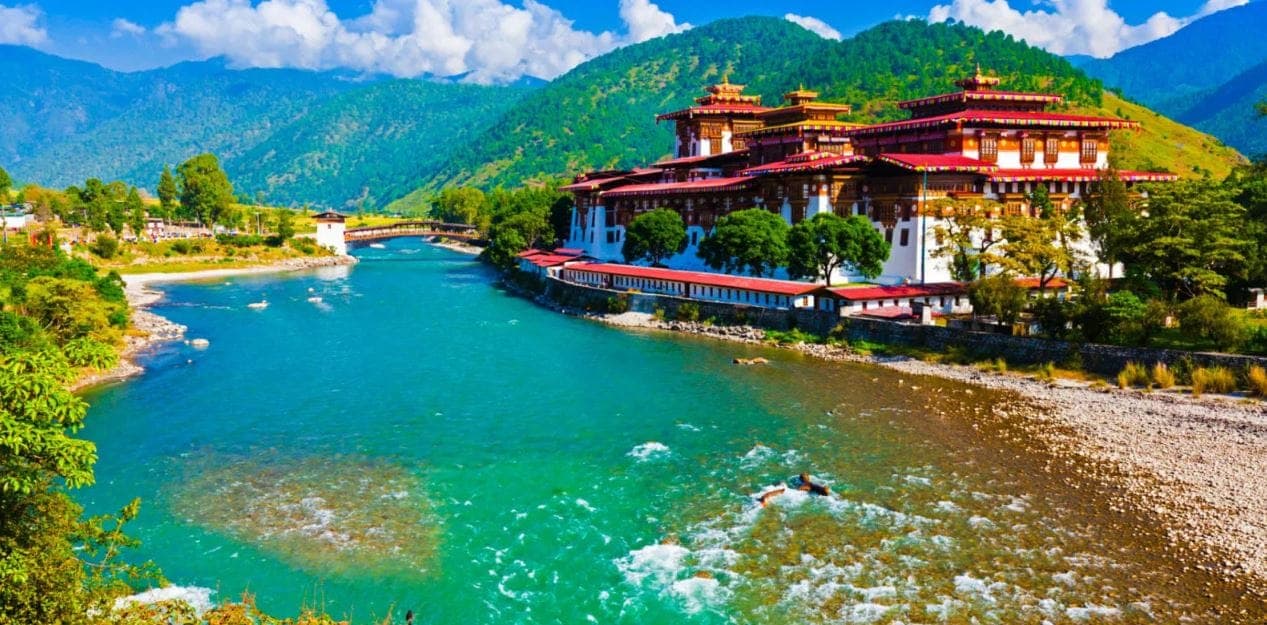
Nestled at the sacred confluence of the Pho Chhu (Male River) and Mo Chhu (Female River), Punakha Dzong stands as arguably the most magnificent fortress-monastery in all of Bhutan. Officially known as Pungthang Dechen Phodrang, or "The Palace of Great Happiness," this 17th-century architectural gem served as Bhutan's capital and administrative center for over 300 years until the mid-20th century. Its strategic location at the river junction, with the backdrop of lush hills and often-dazzling blue skies, creates a scene of perfect harmony that captures the essence of Bhutanese spiritual and architectural genius.

Historical Significance & Architectural Splendor: Built in 1637-38 by Zhabdrung Ngawang Namgyal, the unifier of Bhutan, the dzong represents a masterpiece of traditional Bhutanese architecture. The six-story central tower (utse) rises majestically above the complex, while the courtyards, temples, and administrative offices showcase intricate woodwork, beautiful frescoes, and grand galleries. The dzong has witnessed centuries of history, from the establishment of the Bhutanese state to the coronation of modern kings, and it remains the winter seat of the Central Monastic Body to this day.
Key Features & Spiritual Treasures
- Sacred Relics: The dzong houses Bhutan's most treasured religious artifacts, including the Rangjung Kharsapani, an ancient statue of Avalokiteshvara, and the sacred remains of Zhabdrung Ngawang Namgyal and Tertön Pema Lingpa
- Grand Courtyards: The dzong features several spacious courtyards used for religious ceremonies and festivals, each telling a different chapter of Bhutan's spiritual history
- 100-Pillar Assembly Hall: Though actually supported by 54 pillars, the magnificent Kuenray (assembly hall) features stunning murals depicting the life of Buddha and important moments in Bhutanese Buddhist history
- Colorful Festivals: The dzong hosts the famous Punakha Drubchen and Tshechu, featuring dramatic recreations of 17th-century battles and traditional mask dances
Visitor Experience & Practical Information: The approach to Punakha Dzong is an experience in itself, crossing a traditional wooden-roofed bridge that offers breathtaking views of the fortress. Inside, visitors can explore the courtyards and temples (with a guide), witnessing monks going about their daily rituals against a backdrop of unparalleled architectural beauty. The best time to visit is during spring (March-April) when the jacaranda trees surrounding the dzong burst into magnificent purple blooms, creating a stunning contrast with the whitewashed walls and golden roofs.
Cultural Significance Today: Despite no longer being the administrative capital, Punakha Dzong maintains its importance as a spiritual center and venue for royal ceremonies—including the wedding of King Jigme Khesar Namgyel Wangchuck in 2011. Its continued relevance in both religious and royal life makes it a living monument to Bhutan's enduring cultural traditions.
For any traveler seeking to understand the soul of Bhutan, a visit to Punakha Dzong provides not just a glimpse into the nation's history, but an immersion into its living spiritual heritage—truly earning its name as The Palace of Great Happiness.
Ancient Temple of Kyichu Lhakhang
The serene Paro Valley, Kyichu Lhakhang, stands as one of Bhutan's oldest and most revered temples, representing the country's earliest Buddhist heritage. This sacred site forms part of a chain of 108 temples built across the Himalayan region in the 7th century by the Tibetan Buddhist King Songtsen Gampo, strategically constructed to pin down a giant demoness who was obstructing the spread of Buddhism.

Historical Significance & Legend: According to ancient tradition, Kyichu Lhakhang was one of two temples built in Bhutan (the other being Jambay Lhakhang in Bumthang) to subdue the left foot of the mythical demoness. The temple's establishment marks the introduction of Buddhism to Bhutan and represents one of the kingdom's first sacred structures. For over 1,300 years, it has remained an active place of worship and pilgrimage, maintaining its original spiritual significance through centuries of Buddhist practice.
Architectural Beauty & Sacred Treasures
The temple complex consists of two main prayer halls—the original 7th-century structure and a newer addition built by the Royal Grandmother in 1968. Key features include:
- Jowo Temple: The main sanctuary housing one of Bhutan's most sacred statues—a magnificent image of Jowo Sakyamuni (the young Buddha) believed to be contemporary with the temple's founding
- Ancient Orange Tree: A remarkable tree in the courtyard that miraculously bears fruit throughout the year, considered a sacred manifestation of the temple's spiritual power
- Guru Rinpoche Statue: An exquisite 8th-century image of Padmasambhava, commissioned by the Tibetan king himself
- Intricate Murals: Beautiful wall paintings depicting Buddhist deities and scenes from religious history
- Stone Inscriptions: Ancient carvings preserved within the temple grounds
Spiritual Experience & Visitor Information: Kyichu Lhakhang offers a more intimate and accessible spiritual experience compared to larger dzongs and monasteries. The atmosphere is one of quiet devotion, where local families come for daily prayers and blessings. Visitors can often witness elderly devotees circumambulating the temple, spinning prayer wheels, and counting mantras on their malas.
As one of the kingdom's first Buddhist foundations, Kyichu Lhakhang represents the enduring roots of Bhutan's spiritual consciousness—a place where ancient legends, living faith, and architectural beauty converge to create an unforgettable experience of Bhutan's cultural soul.
Tashichho Dzong - Thimphu's Monarchial Fortress
Standing majestically on the western bank of the Wang Chhu River, Tashichho Dzong serves as the impressive political and religious heart of modern Bhutan. This magnificent fortress-monastery, whose name translates to "Fortress of the Glorious Religion," embodies the unique dual system of governance that defines the Dragon Kingdom, housing both the throne room of the King and the central monastic body.

Historical Evolution & Architectural Grandeur: The dzong's history dates back to 1216 when Lama Gyalwa Lhanangpa built the original structure. However, its current form was established in the 1960s under the command of the Third King, Jigme Dorji Wangchuck, who oversaw a major reconstruction that maintained traditional Bhutanese architectural principles while creating a functional modern seat of government. The massive whitewashed walls, crowned by distinctive golden roofs and red-and-gold accents, stretch over an extensive complex that incorporates traditional Bhutanese woodwork, intricate paintings, and symbolic Buddhist motifs.
Political & Spiritual Significance: Tashichho Dzong serves as the official seat of the Druk Gyalpo (Dragon King) and houses the offices of the King, the throne room, and several government ministries. Simultaneously, it remains the summer residence of the Central Monastic Body, led by His Holiness the Je Khenpo (Chief Abbot of Bhutan). This unique co-existence of temporal and spiritual authority within one complex reflects the fundamental principles of Bhutan's governance and cultural identity.
Key Features & Visitor Experience
- Grand Courtyards: The dzong features multiple spacious courtyards used for religious ceremonies and national celebrations
- Central Tower (Utse): The magnificent three-story utse houses the main temple and most sacred spaces
- Throne Room: The beautifully decorated chamber where important state functions and royal ceremonies occur
- Festival Grounds: The extensive grounds host the spectacular Thimphu Tshechu each autumn
- Landscaped Gardens: Immaculately maintained gardens surround the complex, creating a serene atmosphere
Practical Information for Visitors: The dzong is open to visitors in the evenings after government offices close and on weekends, with guided tours available to explain the historical and cultural significance. The best time to witness the dzong in its full splendor is during the Thimphu Tshechu festival, when the courtyards come alive with colorful mask dances and thousands of devotees. The illuminated dzong at night creates a magical reflection in the adjacent river, offering one of Thimphu's most photogenic scenes.
As both a functioning administrative center and active monastery, Tashichho Dzong represents the living essence of Bhutan's unique political system and cultural heritage—a place where ancient traditions seamlessly blend with modern governance, creating a powerful symbol of the nation's identity and aspirations.
Watchtower of Ta Dzong (National Museum)
Perched majestically on a hill overlooking the Paro Valley, the Ta Dzong presents a unique architectural and cultural experience as Bhutan's National Museum. This ancient watchtower, built in 1656, originally served as a vigilant guardian protecting the nearby Paro Dzong from invading forces. Its circular, conch-shell design—a rare form in Bhutanese architecture—was strategically created to provide 360-degree views of the surrounding valley, making it an impregnable defensive structure.

Historical Transformation: For nearly three centuries, the Ta Dzong stood as a silent sentinel until 1968, when it was transformed into the National Museum of Bhutan. This conversion preserved its historical significance while creating a magnificent repository for the nation's cultural treasures. The building itself represents a masterpiece of Bhutanese military architecture, with its tapering walls, narrow windows for archers, and original stone construction telling the story of Bhutan's martial history.
Museum Collections & Galleries
The museum's spiral layout, ascending through six floors, takes visitors on a chronological journey through Bhutan's cultural evolution:
- Ancient Artifacts: Prehistoric tools, arrowheads, and Bronze Age objects revealing Bhutan's early civilization
- Religious Art: Extraordinary collections of thangkas (scroll paintings) spanning various Buddhist schools, including rare 14th-century works
- Natural History: Exhibits showcasing Bhutan's rich biodiversity, from the endangered takin to butterfly species
- Philatelic Gallery: Bhutan's famous and often unusual postage stamps, including 3D stamps and record discs
- Traditional Weapons: Ancient armor, shields, and weaponry demonstrating Bhutan's military heritage
- Royal Heritage: Personal artifacts and gifts belonging to Bhutan's royal family
Cultural Significance & Visitor Experience: The Ta Dzong offers a comprehensive introduction to Bhutanese culture before exploring the country's other sacred sites. The museum's elevated position provides breathtaking panoramic views of Paro Valley, creating a perfect marriage of cultural immersion and natural beauty. Each level reveals new aspects of Bhutan's heritage, from ritual objects and traditional costumes to agricultural implements and handicrafts, telling the complete story of Bhutanese life through the ages.
Practical Information: The museum is easily accessible from Paro town and makes an ideal starting point for any Paro Valley exploration. Visitors should allocate at least two hours to fully appreciate the collections. The circular walkway naturally guides visitors through the exhibits, while bilingual descriptions (English and Dzongkha) provide valuable context. Note that photography may be restricted in certain galleries to preserve delicate artifacts.
The Ta Dzong now stands not only as a protector of Bhutan's past but as a beacon for its cultural future—offering every visitor a profound understanding of what makes the Kingdom of Bhutan truly unique in the modern world.
Fertility Temple of Chimi Lhakhang
Tucked away in the picturesque Punakha Valley amid rolling rice paddies and traditional villages, Chimi Lhakhang stands as one of Bhutan's most unique and beloved religious sites. Unlike the imposing fortress monasteries that dominate Bhutan's landscape, this charming temple offers a more intimate and unconventional spiritual experience, dedicated to the legendary Buddhist saint Drukpa Kunley, affectionately known as the "Divine Madman."

Historical Origins & The Divine Madman: The temple was constructed in 1499 by the cousin of Drukpa Kunley, following the saint's subjugation of a demoness from nearby Dochu La. According to legend, Kunley trapped the demoness in a rock near the current temple site and commanded that a shrine be built to maintain the protection. Drukpa Kunley himself was no ordinary saint—he was a tantric master who challenged religious hypocrisy through unconventional methods, using humor, song, and often sexual means to transmit spiritual teachings. His phallus symbol became his trademark, and it remains prominently displayed throughout the surrounding village and the temple itself.
Architecture & Spiritual Significance
The temple's architecture reflects its peaceful purpose—a simple, two-story structure with a golden roof and typical Bhutanese woodwork, accessible via a gentle 20-minute walk through rice fields and traditional villages. What makes Chimi Lhakhang extraordinary is its continued association with fertility blessings. The temple houses several sacred relics, including:
- Drukpa Kunley's original wooden phallus: Used for blessing childless couples
- Iron bow and arrows: Belonging to the saint himself
- Stone imprint: Believed to be the body impression of the subdued demoness
The Pilgrimage Experience: The journey to Chimi Lhakhang begins with a walk through the vibrant village of Sopsokha, where nearly every house features painted phallus symbols on the walls—a tradition believed to ward off evil spirits and gossip. The path winds through beautiful agricultural fields, offering glimpses of rural Bhutanese life. Upon reaching the temple, visitors often witness couples seeking fertility blessings receiving "thappings" (gentle strikes on the head) with the saint's wooden phallus and a bow and arrow. The temple's atmosphere is notably joyful and welcoming, reflecting the unconventional nature of its patron saint.
Cultural Context & Modern Relevance: Chimi Lhakhang represents an important aspect of Bhutanese Buddhism that embraces the full spectrum of human experience. The temple welcomes visitors of all faiths and backgrounds, and many local children are named after the Divine Madman in gratitude for successful blessings. The surrounding area has become known as the "Fertility Valley," with numerous international couples attributing their successful pregnancies to visits to this sacred site.
For travelers, Chimi Lhakhang offers a refreshing contrast to Bhutan's more formal religious institutions—a place where spirituality, humor, and human nature intersect in a celebration of life's creative forces, all set against the stunning backdrop of the Punakha Valley's natural beauty.
From the heart-pounding ascent to the cliffside Tiger's Nest to the serene peace of a traditional hot stone bath, the things to do in Bhutan offer more than just a vacation—they promise a profound transformation. This is a kingdom where happiness is measured, where ancient culture breathes in the walls of majestic dzongs, and where every Himalayan vista reminds you of nature's grandeur.
Your journey through Bhutan will leave you with more than just photographs; it will gift you with a renewed sense of wonder. The memories of chanting monks at dawn, the vibrant explosion of a Tshechu festival, and the genuine warmth of the Bhutanese people will linger long after you've returned home. The true magic of Bhutan lies not in checking attractions off a list, but in the quiet moments of connection and the deep, lasting peace you will carry with you.
So, are you ready to answer the call of the Himalayas? Let the Kingdom of Bhutan shift your perspective and capture your heart. Your unforgettable adventure into a world where culture and happiness reign supreme is just beginning.
FAQs for Things to do in Bhutan
Q: What are the top 5 must-do experiences in Bhutan?
A: The essential Bhutan experiences are: 1) Hiking to Tiger's Nest Monastery, 2) Visiting Punakha Dzong, 3) Attending a Tshechu festival, 4) Experiencing a traditional hot stone bath, and 5) Witnessing an archery competition.
Q: When is the best time to visit Bhutan for trekking?
A: The ideal trekking seasons are spring (March-May) and autumn (September-November). These periods offer stable weather, clear mountain views, and comfortable temperatures for outdoor activities.
Q: Do I need to book through a tour operator for Bhutan?
A: Yes, all international visitors must book through licensed Bhutanese tour operators. This policy helps sustain tourism and provides proper guidance throughout your journey.
Q: How challenging is the Tiger's Nest hike?
A: The hike is moderately challenging, taking 4-6 hours round-trip. While the altitude can be demanding, the well-maintained trail and resting points make it achievable for most people with average fitness.
Q: What makes Bhutan's cultural experiences unique?
A: Bhutan offers authentic living culture through farmhouse visits, traditional hot stone baths, vibrant festivals with mask dances, and the opportunity to witness daily Buddhist practices in active monasteries.
Q: What adventure activities are available beyond trekking?
A: Beyond trekking, you can enjoy white water rafting in Punakha, mountain biking through scenic valleys, bird watching for rare species, and cultural hikes to remote villages and temples.
Q: Are there any clothing restrictions for temple visits?
A: Yes, visitors must dress modestly when entering temples and dzongs. Shoulders and knees should be covered, and you'll need to remove shoes and hats before entering sacred spaces.
Q: Can I customize my Bhutan itinerary with specific activities?
A: Absolutely. Reputable tour operators like Nepal Adventure Holidays specialize in creating personalized itineraries that focus on your interests, whether it's photography, meditation, birdwatching, or cultural immersion.
Q: What's the minimum daily package cost for Bhutan tourism?
A: The government-set minimum daily package is typically $200-250 per person (high season), covering accommodation, meals, transport, guide services, and sustainable tourism royalty.
Q: How many days should I spend in Bhutan?
A: We recommend 7-10 days to experience the main cultural highlights of Paro, Thimphu, and Punakha valleys comfortably. For trekking or deeper exploration, 14-21 days are ideal.
.4828dc85.png&w=256&q=75&dpl=dpl_4wpSjHUy1BcszSUAUcwRxno9aXXy "Affiliation 1")
.a14f8e77.png&w=256&q=75&dpl=dpl_4wpSjHUy1BcszSUAUcwRxno9aXXy "Affiliation 2")
.7a169c70.png&w=256&q=75&dpl=dpl_4wpSjHUy1BcszSUAUcwRxno9aXXy "Affiliation 3")
.360ce5ac.png&w=96&q=75&dpl=dpl_4wpSjHUy1BcszSUAUcwRxno9aXXy "Affiliation 4")
.b0c53703.png&w=384&q=75&dpl=dpl_4wpSjHUy1BcszSUAUcwRxno9aXXy "Affiliation 5")
.f0df82a6.png&w=420&q=75&dpl=dpl_4wpSjHUy1BcszSUAUcwRxno9aXXy "Affiliation 6")
.06f9557e.png&w=384&q=75&dpl=dpl_4wpSjHUy1BcszSUAUcwRxno9aXXy "Affiliation 7")